Representations of Indonesia in Dutch Cinema: Media Analysis of the Films De Oost, Gordel van Smaragd, and Oeroeg
Representations of Indonesia in Dutch Cinema: Media Analysis of the Films De Oost, Gordel van Smaragd, and Oeroeg
Keywords:
Colonial Repsentation, Dutch Cinema, Cultural MemoriAbstract
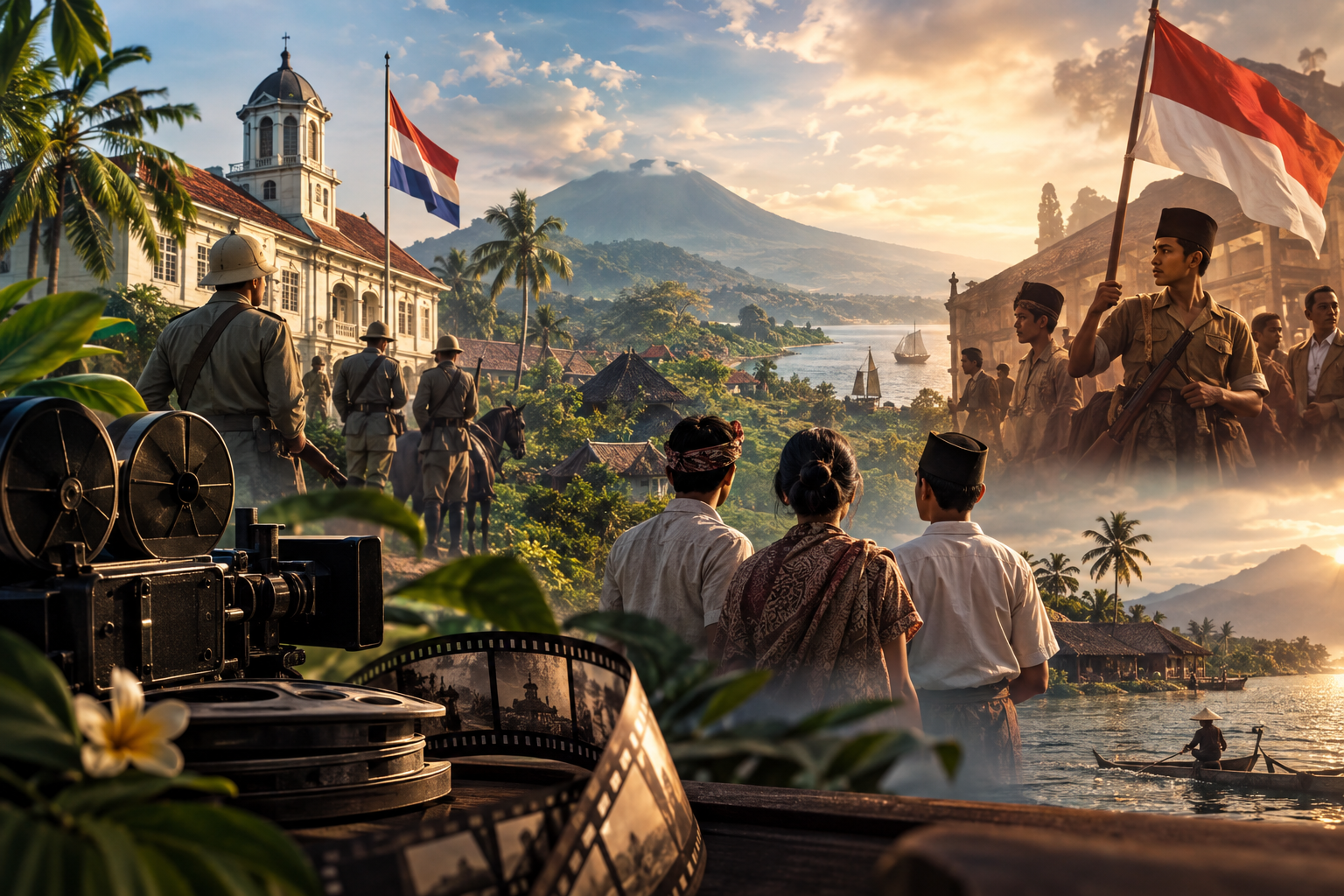
In the modern era, film has become a medium for cultural communication in creating public understanding of history and collective memory. Within the framework of Dutch-Indonesian relations, colonial and post-colonial films not only attempt to show the past, but also become a place for negotiating meanings related to colonialism, violence and national identity. This study seeks to understand how Indonesia and Dutch colonialism are represented in three Dutch films, namely Gordel van Smaragd, Oeroeg and De Oost, and how the representations in these three films serve to frame colonial memory in the public sphere. This study uses a qualitative approach with a comparative media analysis design. The analysis is based on Stuart Hall's framework of representation, supplemented by visual semiotics and postcolonial discourse analysis. Various data are analysed through the identification of narratives, characters, visuals, and storytelling structures in the three films to reveal patterns of representation. The results of the study show that the three Dutch films consistently focus the narrative perspective on the experiences of Dutch characters. Gordel van Smarang frames colonialism with imperial nostalgia that normalises colonial life. Meanwhile, the film Oeroeg attempts to reflect on the post-colonial situation in a more critical manner, although it still limits itself to the moral dilemmas of Dutch characters.
References
Arya, A. E., & Sokowati, M. E. (2024). The Representation of Javanese People in the Film" De Oost" by Jim Taihuttu: A Semiotic Analysis by Roland Barthes. Jurnal Audiens, 5(4), 698–710.
Balfas, O., & Nugraha, F. M. (2023). RAYMOND WESTERLING’S REPRESENTATION OF DE TURK CHARACTER IN THE FILM “DE OOST”(2020). International Review of Humanities Studies, 8(2), 17.
Barthes, R. (1977). Image, Music, Text. Fontana Press.
Barus, E., Aisyah, A., Siregar, E. F., & Risnawaty, R. (2025). An analysis of Roland Barthes’ semiotic theory: Focusing on denotation, connotation, and myth. International Journal of Educational Research Excellence, 4(2), 355–363.
Bijl, P. (2013). Dutch colonial nostalgia across decolonisation. Journal of Dutch Literature, 4(1).
Doolan, P. M. M. (2021). Collective memory and the Dutch East Indies: unremembering decolonization. Amsterdam University Press.
Edgerton, G. R., & Rollins, P. C. (2001). Television histories: Shaping collective memory in the media age. University Press of Kentucky.
Fabian, L. Y. (2025). Oeroeg and Bumi Manusia: Flipside of the Coin on Dutch Colonialism in Indonesia. Leiden University.
Fiveable. (2025, July 25). Foundations of postcolonial film theory – Intro to Film Theory. . Https://Fiveable.Me/Introduction-to-Film-Theory/Unit-11/Foundations-Postcolonial-Film-Theory/Study-Guide/BCuooq6hyUfz5yM6.
Gavrilov, A. S., & Zueva, E. G. (2025). The Image of the African Other in French Cinema During the Collapse of the Colonial Empire, 1945-1960. Vestnik RUDN. International Relations, 25(2), 223–235.
Hall, S. (1980). Culture, Media, Language. . Routledge.
Harrill, R., Dioko, L. D. A. N., & Oshriyeh, O. (2025). Music films and videos as recolonizing media in tourism. Annals of Tourism Research, 114, 104010.
Immler, N. L. (2022). The Netherlands-Indies; Rethinking post-colonial recognition from a multi-voiced perspective. Wacana, Journal of the Humanities of Indonesia, 23(3), 8.
Jonker, D. (2023). From Oeroeg to De Oost.
Kopp, D. (2024). Vertolking van De Oost: Intergenerational Memories of Dutch Perpetration during the Indonesian War of Independence in De Tolk van Java, De Oost and Kleinkinderen van de Oost.
Lorcin, P. M. E. (2018). 3. The nostalgias for empire. History and Theory, 57(2), 269–285.
Mirzoeff, N. (2011). The right to look. Critical Inquiry, 37(3), 473–496.
Nugroho, W. B. (2020). The Brief Explanation of Representation according Stuart Hall. Udayana Networking, 4.
Pattynama, P. (2025). Cultural memory and Indo-Dutch identity formations. In Post-Colonial immigrants and identity formations in the Netherlands (pp. 175–192). Routledge.
Piro, J. M. (2008). Foucault and the architecture of surveillance: Creating regimes of power in schools, shrines, and society. Educational Studies, 44(1), 30–46. https://doi.org/https://doi.org/10.1080/00131940802225036
Plantinga, C. (2021). Collective Memory and the Rhetorical Power of the Historical Fiction Film. Global Storytelling: Journal of Digital and Moving Images, 1(1). https://doi.org/https://doi.org/10.3998/gs.855
Ponzanesi, S., & Mendes, A. C. (2022). Screening postcolonial intellectuals: cinematic engagements and postcolonial activism. In Transnational screens (pp. 1–9). Taylor & Francis.
Remco Vermeulen. (2021, July 21). De Oost’: Learning from a controversial feature film. Dutchculture.
Rose, G. (2022). Visual methodologies: An introduction to researching with visual materials.
Rozzaq, A. C., & Ratnadewi, D. (2016). Critical Discourse Analysis Related to Power Relation in Film †œThe Judgeâ€. Tell: Teaching of English Language and Literature Journal, 4(1), 10–22.
Said, E. W. (1978). Orientalism. New York: Pantheon Books.
Sasongko, A. (2017). Ideologi Representasi Identitas dalam Film Adaptasi Oeroeg. Jurnal Seni Nasional Cikini, 1(1), 45–57.
Tempo English. (2021, May 31). De Oost Movie Rips Open Dutch Colonial Wounds .
Uppal, A. G. (2025). Cultural Memory in Context: Interdisciplinary Perspectives. Savani University.
Wiesner, C. (2022). Doing qualitative and interpretative research: reflecting principles and principled challenges. Political Research Exchange, 4(1), 2127372. https://doi.org/https://doi.org/10.1080/2474736X.2022.2127372
Zheng, T., Li, Y., & Chu, Y. (2024). The Writing of Cultural Memory in the New Mainstream Film. 2024 10th International Conference on Humanities and Social Science Research (ICHSSR 2024), 1332–1337.
Downloads
Published
How to Cite
Issue
Section
Categories
License
Copyright (c) 2026 Danil Kasputra, Alila Pramiyanti, Betty Tresnawaty, Maylanny Christin

This work is licensed under a Creative Commons Attribution 4.0 International License.