Refiguration of Democratic Communication in the Digital Public Sphere
Refigurasi Komunikasi Demokratis dalam Ruang Publik Digital
Keywords:
Digital Activism, Digital Democracy, Public Sphere, Social MediaAbstract
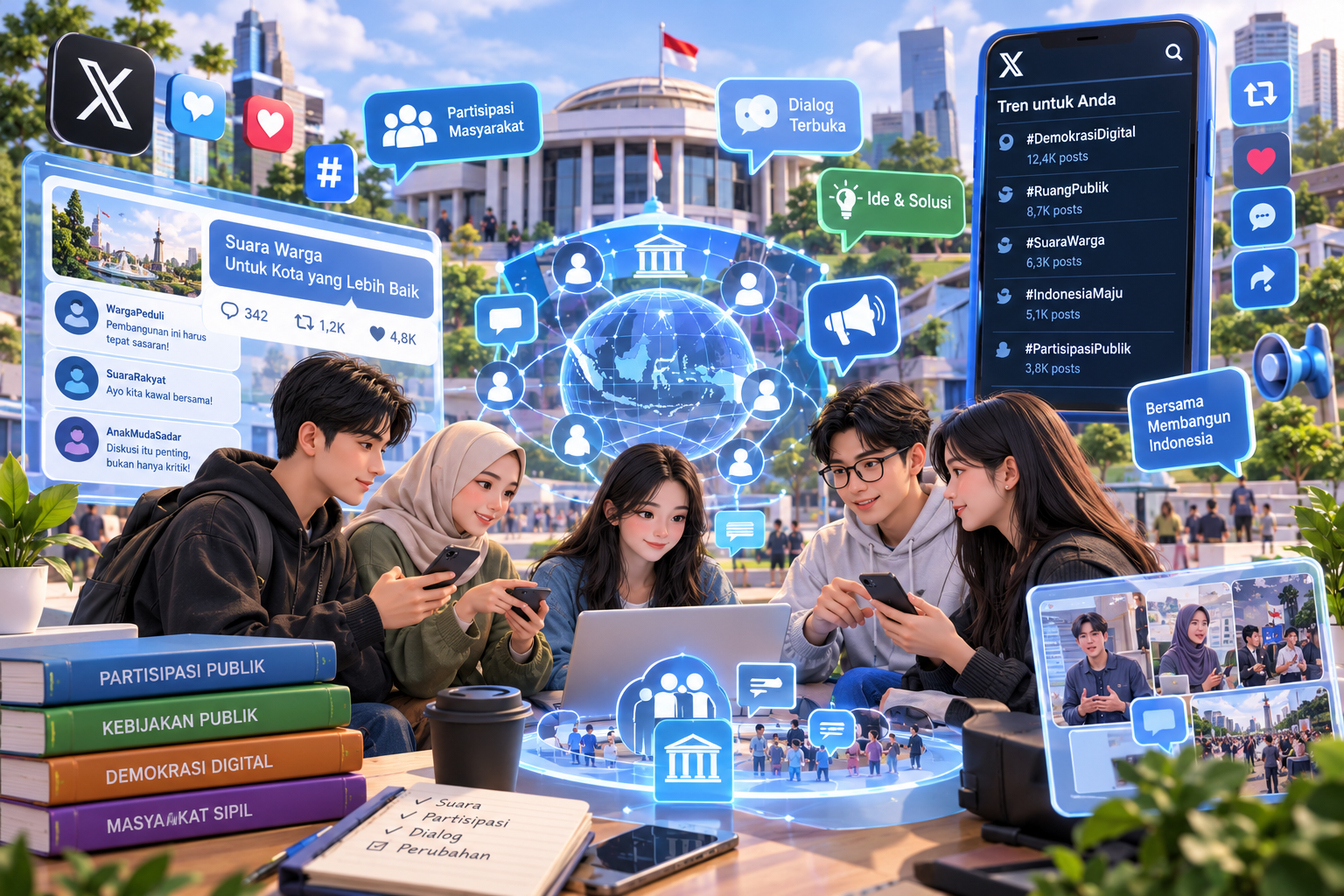
Social media has become an integral part of modern life and serves as a platform for social interaction, information dissemination, and public participation. The presence of social media also allows for active dialogue that can shape new currents in the field of digital activism. This study aims to explore the relationship between social media and the transformation of public space and understand its application to society. The study focuses on Instagram as a visual-based platform to analyze social media facilitating the expansion of public space into visual activism that transcends spatial, temporal, and geographical boundaries. The research findings obtained that @demokrasidigital seeks to create a future of hybrid activism by utilizing public space in new ways. This begins through online community connections, then in general the virtual world is able to attract more people. Digital democracy is not only a new phenomenon, but also makes communication more democratic by expanding the scope of its followers and this also proves that public discourse can occur in a virtual environment.
References
rethinking the public sphere in the age of social Media. Социологическое обозрение, 88-102.
Anggara, S., & Pratama, H. S. (2019). Masyarakat Jejaring, Media Sosial, dan Transformasi Ruang Publik: Refleksi Mengenai Fenomena Arab Spring dan “Teman Ahok”. Paradigma, 287-310.
Bakhshi, S., Shamma, D. A., & Gilbert, E. (2014). Faces engage us: Photos with faces attract more likes and comments on Instagram. Proceedings of the SIGCHI Conference on Human Factors in Computing Systems (pp. 965–974). Association for Computing Machinery. https://doi.org/10.1145/2556288.2557403
Benkler, Y. (2006). The wealth of networks: How social production transforms markets and freedom. Yale University Press.
Bennett, W. L., & Segerberg, A. (2013). The logic of connective action: Digital media and the personalization of contentious politics. Cambridge University Press. https://doi.org/10.1017/CBO9781139198752
Bo'do, S., Siahaan, H., & Ida, R. (2019). Diskusi Media Sosial, Ruang Publik dan Gerakan Pertanian Perkotaan di Indonesia. Budapest International Research and Critics Institute-Journal (BIRCI-Journal), 250-261.
Boulianne, S., Lalancette, M., & Ilkiw, D. (2020). School strike 4 climate: Social media and the international youth protest on climate change. Media and Communication, 8(2), 208–218. https://doi.org/10.17645/mac.v8i2.2768
Castells, M. (2010). The Rise of the Network Society. Chichester: Wiley-Blackwell.
Christmann, G. B., Knoblauch, H., & Löw, M. (Eds.). (2022). Communicative constructions and the refiguration of spaces: Theoretical approaches and empirical studies. Routledge. https://doi.org/10.4324/9780367817183
Couldry, N., & Mejias, U. A. (2019). The costs of connection: How data is colonizing human life and appropriating it for capitalism. Stanford University Press. https://doi.org/10.1515/9781503609754
Dahlgren, P. (2013). The political web: Media, participation and alternative democracy. Palgrave Macmillan.
Fraser, N. (2024). Rethinking the Public Sphere: A Contribution to the Critique of Actually Existing Democracy 1. In New Critical Writings in Political Sociology. Routledge, 489-513.
Fuchs, C. (2014). Social media: A critical introduction (2nd ed.). Sage Publications.
Habermas, J. (1962). The Structural Transformation of the Public Sphere. Cambridge, Massachusetts : MIT Press.
Jenkins, H., Ford, S., & Green, J. (2013). Spreadable media: Creating value and meaning in a networked culture. New York University Press.
Kwok, C., & Chan, N. K. (2024). Human-automated collectives: Automating communication for social movement mobilization. New Media & Society. https://doi.org/10.1177/14614448241251794
Lengauer, D. (2018). Sharing semangat taqwa: social media and digital Islamic socialities in Bandung. Indonesia and the Malay world, 5-23.
Li, M., Suk, J., Zhang, Y., Pevehouse, J. C., Sun, Y., Kwon, H., Lian, R., Wang, R., Dong, X., & Shah, D. V. (2026). Platform affordances, discursive opportunities, and social media activism: A cross-platform analysis of #MeToo on Twitter, Facebook, and Reddit, 2017-2020. New Media & Society, 28(1), 119-147.
Littlejohn, S. W., & Foss, K. A. (2009). Encyclopedia of communication theory (Vol. 1). California: Sage Publications.
Mendes, K., Ringrose, J., & Keller, J. (2018). #MeToo and the promise and pitfalls of challenging rape culture through digital feminist activism. European Journal of Women's Studies, 25(2), 236–246. https://doi.org/10.1177/1350506818765318
Mossberger, K., Tolbert, C. J., & McNeal, R. S. (2008). Digital citizenship: The Internet, society, and participation. MIT Press.
Papacharissi, Z. (2015). Affective publics: Sentiment, technology, and politics. Oxford University Press. https://doi.org/10.1093/acprof:oso/9780199999736.001.0001
Robi’ah, S. N. (2020). Media Sosial sebagai Ruang Publik Virtual Bagi Mahasiswa Universitas Islam Negeri Sunan Ampel Surabaya. Jurnal PUBLIQUE, 21-44.
Romero, D. L. (2016). Social Media, Civic Engagement, and Local Governments: Special Consideration to the Office of the Mayor of NYC. International Journal of Civic Engagement and Social Change (IJCESC), 14-24.
Sekaran, U., & Bougie, R. (2018). Metode Penelitian untuk Bisnis. Jakarta: Penerbit Salemba Empat.
Şen, A. F., & Bolumu-Elazig, İ. F. (2012). The social media as a public sphere: The rise of social opposition. International Conference on Communication, Media, Technology and Design (pp. 490-494). Istanbul: Retrieved from http://www. cmdconf. net/2012/makal.
Setiawan, F. R. (2023). Peran Media Sosial Sebagai Ruang Publik: Tinjauan Filosofis Gagasan Ruang Publik Jürgen Habermas. Melintas, 323-350.
Shirky, C. (2011). The political power of social media: Technology, the public sphere, and political change. Foreign affairs, 28-41.
Sunstein, C. R. (2018). #Republic: Divided democracy in the age of social media. Princeton University Press. https://doi.org/10.1515/9781400890521
Thompson, J. B. (1995). The Media and Modernity: A SOCIAL THEORY OF THE MEDIA. Cambridge: Polity Press.
Tufekci, Z. (2017). Twitter and tear gas: The power and fragility of networked protest. New Haven: Yale University Press.
Van Dijck, J., Poell, T., & de Waal, M. (2018). The platform society: Public values in a connective world. Oxford University Press. https://doi.org/10.1093/oso/9780190889760.001.0001
Downloads
Published
How to Cite
Issue
Section
Categories
License
Copyright (c) 2026 Destita Mutiara, MHafizh Renaldi

This work is licensed under a Creative Commons Attribution 4.0 International License.