Maqāṣid Syarīʿah Da'wah Journalism Model in PTKIN Hajj Guidance
Model Jurnalistik Dakwah Berbasis Maqāṣid Syarīʿah dalam Bimbingan Haji PTKIN
Keywords:
Da'wah Journalism, Maqāṣid Syarīʿah, KBIH, GatekeepingAbstract
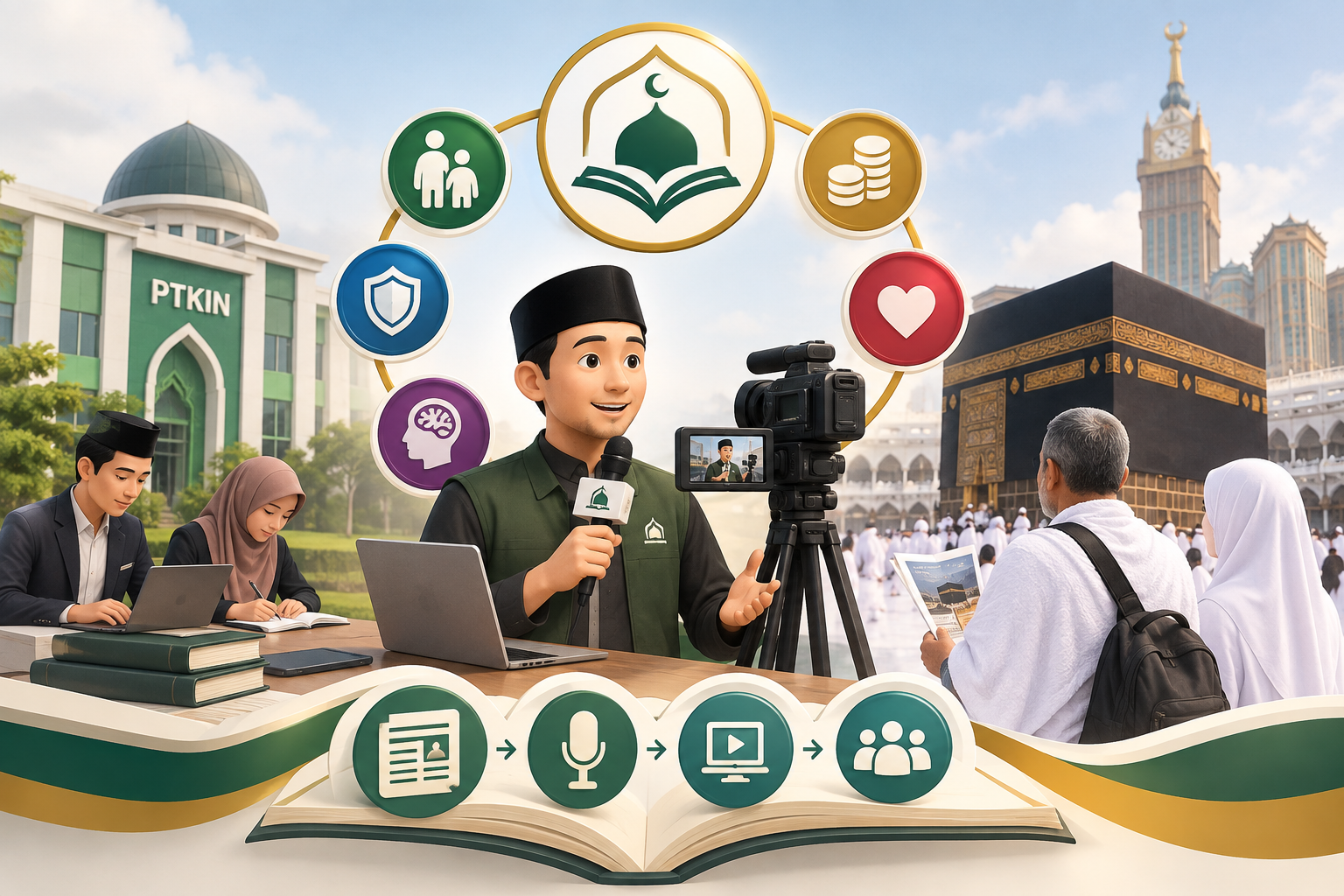
This article aims to formulate a maqāṣid syarīʿah-based journalistic model of da'wah in the practice of KBIH-PTKIN Hajj guidance by integrating conceptual and empirical approaches. The research uses a qualitative approach with a case study design limited to the practice of manasik guidance in the PTKIN environment, supported by literature studies and document analysis. Data were obtained through analysis of the manasik module, limited observation, and semi-structured interviews with KBIH guides. The results show that Hajj guidance can be understood as a practice of journalistic da'wah involving the processes of gatekeeping, framing, and distribution of religious messages based on maqāṣid values. Maqāṣid syarīʿah functions as an editorial ideology that directs the selection and construction of messages, while PTKIN acts as a value curation institution that ensures the consistency of a moderate and contextual religious orientation. This study offers an operational model consisting of three layers: ideological (maqāṣid), operational (gatekeeping-framing), and distributional (multimodal digital). This model emphasizes that manasik is not only instructional in nature, but also a process of constructing religious meaning. The main contribution of this article is to present a new perspective in the study of Islamic journalism by positioning the Hajj rituals as a practice of producing religious discourse based on systemic, adaptive, and transformative values.
References
Al-Ghazali. (1997). Al-Mustasfa fi ilm al-usul. Dar al-Kutub al-‘Ilmiyah.
Al-Syatibi, A. I. (1996). Al-Muwafaqat fi usul al-shariah. Dar al-Ma’arif.
Auda, J. (2008). Maqasid al-shariah as philosophy of Islamic law: A systems approach. International Institute of Islamic Thought.
Azra, A. (2012). Pendidikan Islam: Tradisi dan modernisasi. Kencana.
Bianchi, R. R. (2004). Guests of God: Pilgrimage and politics in the Islamic world. Oxford University Press.
Couldry, N., & Hepp, A. (2017). The mediated construction of reality. Polity Press.
Daradjat, Z. (2017). Ilmu komunikasi Islam. Bumi Aksara.
Entman, R. M. (1993). Framing: Toward clarification of a fractured paradigm. Journal of Communication, 43(4), 51–58.
Esposito, J. L. (2011). What everyone needs to know about Islam. Oxford University Press.
Habermas, J. (1989). The structural transformation of the public sphere. MIT Press.
Hefner, R. W. (2011). Shari’a politics: Islamic law and society in the modern world. Indiana University Press.
Hjarvard, S. (2013). The mediatization of culture and society. Routledge.
Intizam, I. (2024). The urgency of priority jurisprudence in the Hajj: Maqasid syariah approach to optimizing ritual implementation. Journal of Islamic Studies, 5(2).
Katz, E., & Lazarsfeld, P. F. (1955). Personal influence: The part played by people in the flow of mass communications. Free Press.
Kementerian Agama Republik Indonesia. (2022a). Pedoman pembinaan manasik haji. Direktorat Jenderal Penyelenggaraan Haji dan Umrah.
Kementerian Agama Republik Indonesia. (2022b). Kemenag dorong PTKIN gelar sertifikasi pembimbing manasik haji.
Marpudin, A., Wasliman, I., Hanafiah, H., & Koswara, N. (2022). Moderate Hajj: Management of Hajj manasik guidance based on religious moderation. Ilmu Dakwah: Academic Journal for Homiletic Studies, 16(2).
Marsudi, M., & Aisyah, N. (2022). Digitalisasi materi bimbingan haji KBIHU Aisyiyah Bantul. Jurnal Pengabdian dan Pemberdayaan Masyarakat, 6(2).
Masrudi, M., et al. (2022). Strategi komunikasi dalam bimbingan haji berbasis jamaah. Jurnal Dakwah Kontemporer, 4(1).
McQuail, D. (2010). McQuail’s mass communication theory (6th ed.). Sage Publications.
Memish, Z. A., et al. (2019). Mass gathering medicine: Public health issues arising from mass gatherings. The Lancet.
Moleong, L. J. (2017). Metodologi penelitian kualitatif. Remaja Rosdakarya.
Nasr, S. H. (2002). Islamic life and thought. ABC International Group.
Rakhmat, J. (2007). Psikologi komunikasi. Remaja Rosdakarya.
Saragih, M. Y. (2024). Innovation of worship ecosystem transformation: Communication strategy and development of Hajj-Umrah travel based on PTKIN-Kemenag RI. Journal of Education Sciences, 8(4).
Shoemaker, P. J., & Vos, T. (2009). Gatekeeping theory. Routledge.
Sudarto, A., Nita, M. W., & Cahyono, K. (2023). Maqashid syariah dalam manajemen penyelenggaraan ibadah haji. Jurnal Manajemen Haji dan Umrah, 3(1).
Umar, N. (2020). Maqasid syariah: Landasan moderasi Islam. Kementerian Agama RI.
Yasfin, M. A. (2024). Perencanaan dan pengorganisasian layanan bimbingan manasik haji. Jurnal Manajemen Dakwah, 9(2).
Yasfin, M. A. (2025). Transformasi digital dalam bimbingan haji. Jurnal Dakwah Digital, 2(1).
Downloads
Published
How to Cite
Issue
Section
Categories
License
Copyright (c) 2026 M. Yoserizal Saragih, Depi Lisnawati

This work is licensed under a Creative Commons Attribution 4.0 International License.