Analysis of the Use of TikTok Filter Bubble to Increase Content Engagement on Clipper Accounts
Analisis Pemanfaatan Filter Bubble TikTok untuk Meningkatkan Engagement Konten pada Akun Clipper
Keywords:
TikTok, Algorithm, Clipper, EngagementAbstract
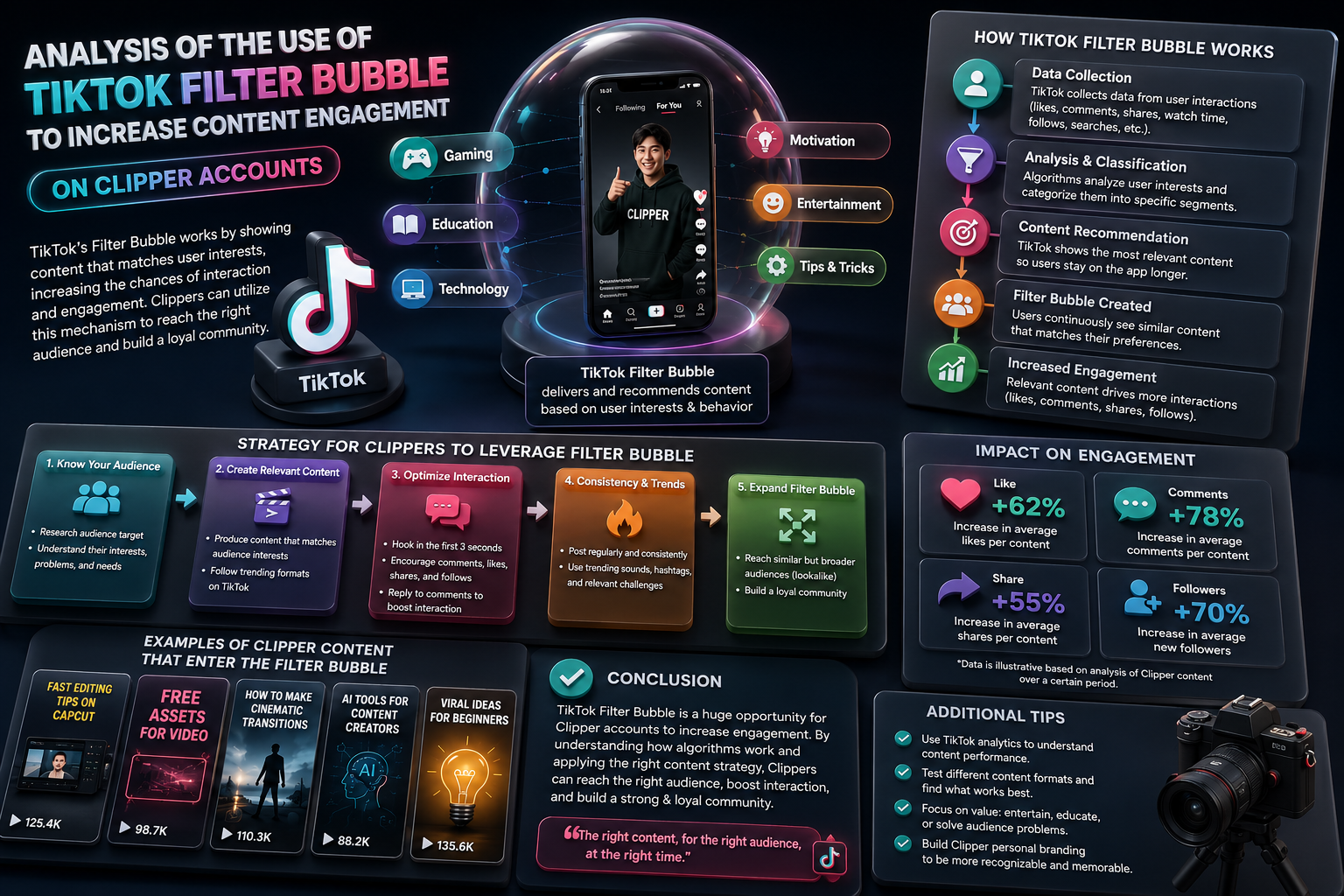
This study aims to analyze the utilization of the Filter Bubble phenomenon on TikTok to increase content engagement on Clipper accounts. TikTok uses a personalization-based recommendation system through the For You Page (FYP), which distributes content according to user interests, interaction history, and viewing behavior. In this study, Filter Bubble is examined through three analytical dimensions: information personalization, algorithmic curation, and selective exposure. The research employed a descriptive qualitative method. Data were collected through interviews, virtual observation, and documentation of five Clipper accounts, with @Juaaan as the main informant and @mugniXD, @SuperstarJumbo, @futuregrow.id, and @traeditz98 as supporting informants. The findings show that Clipper accounts utilize trending topics, distinctive editing styles, and content repackaging strategies to increase views, likes, comments, shares, and audience retention. The TikTok algorithm then strengthens the distribution of highly interactive content, creating repeated exposure to similar topics and sustaining engagement growth. This study confirms that Filter Bubble can be understood not only as a risk in digital communication, but also as a strategic opportunity for content visibility when applied ethically, creatively, and systematically.
References
Ali, D. J., & Eriyanto. (2021). Political polarization and selective exposure of social media users in indonesia. Jurnal Ilmu Sosial Dan Ilmu Politik, 24(3), 268–283. https://doi.org/10.22146/JSP.58199
Baumann, F., Arora, N., Rahwan, I., & Czaplicka, A. (2025). Dynamics of Algorithmic Content Amplification on TikTok. http://arxiv.org/abs/2503.20231
Boeker, M., & Urman, A. (2022a). An Empirical Investigation of Personalization Factors on TikTok. WWW 2022 - Proceedings of the ACM Web Conference 2022, 2298–2309. https://doi.org/10.1145/3485447.3512102
Boeker, M., & Urman, A. (2022b). An Empirical Investigation of Personalization Factors on TikTok. Proceedings of the ACM Web Conference 2022, 2298–2309. https://doi.org/10.1145/3485447.3512102
Eslami, S. P., Ghasemaghaei, M., & Hassanein, K. (2022). Understanding consumer engagement in social media: The role of product lifecycle. Decision Support Systems, 162. https://doi.org/10.1016/j.dss.2021.113707
Fajarini, S. D., Yuliani, F., & Kurniawati, J. (2025). Peran Algoritma Media Sosial Dalam Membentuk Filter Bubble Dan Echo Chamber Di Kalangan Milenial Dan Gen Z Kota Bengkulu. Jurnal Sarjana Ilmu Komunikasi (J-SIKOM), 6(1), 205–226. https://doi.org/10.36085/jsikom.v6i1.8456
Fatimah, A. F., & Nasir, M. (n.d.). Utilization of Short Form Videos (TikTok, Reels, Shorts) to Increase Brand Engagement and Visibility.
Hill, C. A. ., Dean, Elizabeth., & Murphy, Joe. (2014). Social media, sociality, and survey research. John Wiley & Sons, Inc.
Imawan, K. (2019). Instagram as the Dispute Arena of Personal Branding of Local Head Candidates in West Java Province at 2018.
Juan. (2025). Hasil Wawancara.
Kawasaki, Guy., & Fitzpatrick, Peg. (2014). The art of social media : power tips for power users. Portfolio.
Ling, C., Blackburn, J., De Cristofaro, E., & Stringhini, G. (2022). Slapping Cats, Bopping Heads, and Oreo Shakes: Understanding Indicators of Virality in TikTok Short Videos. 14th ACM Web Science Conference 2022, 164–173. https://doi.org/10.1145/3501247.3531551
Liu, N., Emily Hu, X., Savas, Y., Baum ID, M. A., Berinsky ID, A. J., B Chaney, A. J., Lucas, C. I., Mariman, R., de Benedictis-Kessner, J., Guess, A. M., Knox, D., Stewart, B. M., & Evans, J. (2025). Short-term exposure to filter-bubble recommendation systems has limited polarization effects: Naturalistic experiments on YouTube. https://doi.org/10.1073/pnas
Meyliana Tjan Mulyadi, Nur Laili Isnawati, & Catharina Aprilia Hellyani. (2023). Analisis Tiga Dimensi Short Video Marketing Yang Mempengaruhi Purchase Intention Generasi Z. Wawasan : Jurnal Ilmu Manajemen, Ekonomi Dan Kewirausahaan, 1(3), 233–243. https://doi.org/10.58192/wawasan.v1i3.909
Moleong, L. J. . (2019). Metodologi penelitian kualitatif. PT Remaja Rosdakarya.
Montag, C., Yang, H., & Elhai, J. D. (2021). On the Psychology
of TikTok Use: A First Glimpse From Empirical Findings. Frontiers in Public Health, 9. https://doi.org/10.3389/fpubh.2021.641673
Mugni, Muhamad Azka Riyan, Rafid Hidayat, & Ditta Nugraha. (2025). Hasil Wawancara.
Nur Laila, K., & Yanti, S. M. (n.d.). AN-NASHIHA : Journal of Broadcasting and Islamic Communication Studies AN-NASHIHA : Journal of Broadcasting and Islamic Communication Studies Proses Editing Video Konten Pada Adobe Premier Pro Di Tv9 Nusantara Surabaya. 2(2), 2022–2023. https://doi.org/10.55352/an-nashiha
Pariser, Eli. (2011). The filter bubble : how the new personalized web is changing what we read and how we think. Penguin Books.
Perdana Siregar, A., & Setiawan, W. J. (2025). Digital Content Strategy: How Social Proof Influences Purchasing Decisions. Journal of Business Studies and Management Review (JBSMR), 8(2).
Su, C., Zhou, H., Gong, L., Teng, B., Geng, F., & Hu, Y. (2021). Viewing personalized video clips recommended by TikTok activates default mode network and ventral tegmental area. NeuroImage, 237, 118136. https://doi.org/10.1016/j.neuroimage.2021.118136
Tania, S. (2023). Mengeksplorasi Paradoks Privasi Gen-Z Dalam Personalisasi Iklan Di Media Digital. In Jurnal Ilmu Komunikasi (Vol. 12, Number 1).
Wang, C. (2025). Algorithmic Curation and Feminist Discourse: How Rednote’s Digital Media Logic Shapes Empowerment Narratives. Journal of Humanities, Arts and Social Science, 9(5), 1007–1014. https://doi.org/10.26855/jhass.2025.05.024
Wibawa Arifien, T., Prima Ghanistyana, L., Briliyanda, N., Sukma Dewi, A., & Pitri Yani, S. (2025). Peran Algoritma AI dalam Personalisasi Konten dan Filter Bubble A R T I C L E I N F O. https://doi.org/10.29313/jrpr.v5i1.6979
Wulandari, V., Rullyana, G., & Ardiansah, A. (2021). Pengaruh algoritma filter bubble dan echo chamber terhadap perilaku penggunaan internet. Berkala Ilmu Perpustakaan Dan Informasi, 17(1), 98–111. https://doi.org/10.22146/bip.v17i1.423
Zawacki, E. E., Bohon, W., Johnson, S., & Charlevoix, D. J. (2022). Exploring TikTok as an effective platform for geoscience communication. https://doi.org/10.5194/egusphere-2022-494
Zhang, Z., Qiu, K., & Ye, Y. (2025). Influence of audiovisual features of short video advertising on consumer engagement behaviors: Evidence from TikTok. Journal of Business Research, 201, 115662. https://doi.org/10.1016/j.jbusres.2025.115662
Downloads
Published
How to Cite
License
Copyright (c) 2026 Ilham Muhammad, Khaerudin Imawan, Yanto Heryanto

This work is licensed under a Creative Commons Attribution 4.0 International License.