K-pop Fandom Culture NCT in Social Media X: Netnografi of Communication, Interaction and online identity
Budaya Fandom K-pop NCT di Media Sosial X: Netnografi Komunikasi, Interaksi dan Identitas online
Keywords:
K-Pop Fandom Culture, Netnography, Digital Communication, Online IdentityAbstract
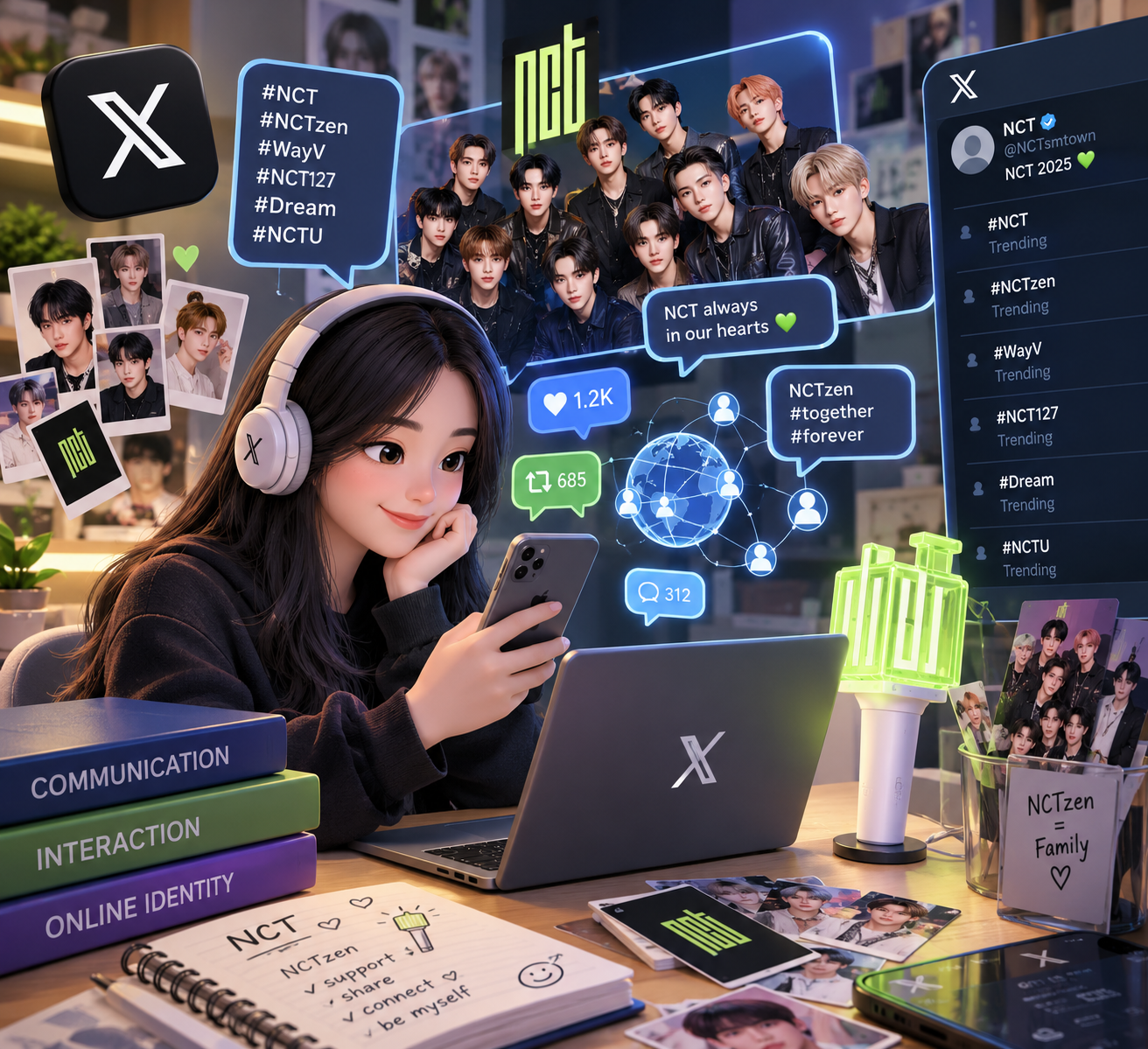
Social media platform X has become a primary space for K-Pop fans to build their culture, but understanding of online identity, digital interactions, and fandom dynamics on the platform remains limited. The purpose of this study is to explain K-Pop fandom culture on social media platform X in these three aspects. The study used a qualitative approach with netnography methods. Data collection techniques included online observation, virtual interviews (direct messages and voice calls on X), online literature review, and online documentation (screenshots). Five informants (active fans, base admins, AU authors, PC collectors) were selected, with criteria of at least one year of active time on X and daily interaction intensity. The results of the study reveal three main findings. First, online identity is constructed through profile elements as a statement of fandom affiliation, with anonymity as a protective strategy and a space for authentic expression. Second, digital interactions are stratified between public (reply) and private (DM) spaces based on context. Third, fandom dynamics reflect a mature community through collective practices (streaming parties, hashtags), a trust-based economic ecosystem (photocard trading), and self-regulatory mechanisms such as fanwar avoidance and distributed governance.
References
Astari, D. W., Agustina, D. P., & Nurussa'adah, E. (2024). Symbolic Reality Construction of the K-Pop Community on Twitter. Interaksi: Jurnal Ilmu Komunikasi, 13(1), 152-168. https://doi.org/10.14710/interaksi.13.1.152-168
Bangun, C. R. (2019). Participatory Culture: A Study On Bangtan Boys Fandom Indonesia. KOMUNIKA: Jurnal Dakwah Dan Komunikasi, 13(2). https://doi.org/10.24090/komunika.v13i2.2539
Bangun, C. R. A. (2019). Participatory Culture: A Study On Bangtan Boys Fandom Indonesia. Komunika: Jurnal Dakwah dan Komunikasi, 13(2). https://doi.org/10.24014/komunika.v13i2.10553
boyd, d. (2010). Taken Out of Context: American Teen Sociality in Networked Publics [Doctoral dissertation, University of California, Berkeley].
boyd, d. (2014). It's Complicated: The Social Lives of Networked Teens. Yale University Press.
Cho, M. (2022). Anonymous, QAnon, Tik-tok teens, K-pop fans. NECSUS: European Journal of Media Studies, 11(1), 169-193. https://doi.org/10.25969/mediarep/18842
Cho, M. (n.d.). EUROPEAN JOURNAL OF MEDIA STUDIES www.necsus-ejms.org Anonymous, QAnon, Tik-tok teens, K-pop fansnecsus-ejms.org/anonymous-qanon-tik-tok-teens-k-pop-fans.
Dewi, R. N., Abidin, Z., Ema, Kaddi, S. M., & Fahrianoor. (2025). Aktivitas Mendukung Virtual Fan Account Fandom NCT (NCTZEN) dalam Bermedia Sosial X. Jurnal Netnografi Komunikasi, 3(2), 104-115.
Hudiyanti, D., Radifar, M., Raharjo, T. J., Narsito, N., & Noegrohati, S. (2014). A Coarse-Grained Molecular Dynamics Simulation Using NAMD Package to Reveal Aggregation Profile of Phospholipids Self-Assembly in Water. Journal of Chemistry, 2014(1), 273084. https://doi.org/10.1155/2014/273084
Kozinets, R. V. . (2015). Netnography : redefined. SAGE Publications.
Lee, S., & Yoon, K. (2025). From Local to Transnational: The Role of X in Shaping K-pop Fandom Identities in Southeast Asia. Asian Journal of Communication, 35(2), 180-198. https://doi.org/10.1080/01292986.2025.2314567
Maharani, F., & Astuti, S. W. (2024). Pola Komunikasi Virtual Dalam Aksi Boycott Idol Kpop: Studi Netnografi pada hastag NCT X Starbuck di media sosial X. Jurnal Social Library, 4(2), 360-364. https://doi.org/10.51849/sl.v4i2.278
Maharani, F., & Astuti, W. (2024). Analisis Jaringan Twitter pada Interaksi Penggemar K-pop Menggunakan Pendekatan Social Network Analytic. Jurnal Communio: Jurnal Ilmu Komunikasi, 13(1). https://doi.org/xxxxx
Marwick, A. E. (2013). Status Update: Celebrity, Publicity, and Branding in the Social Media Age. Yale University Press.
Nafika, E. D. (2026). Dramaturgi Fans K-Pop NCT Pada Generasi Z di Media Sosial X. Jurnal Komunikan, 5(1). https://doi.org/10.30993/jurnalkomunikan.v5i1.783
Nam, K., Kim, H., Kang, S., & Kim, H. (2024). The BTS ARMY on Twitter flocks together: How transnational fandom on social media build a viable system. Telematics and Informatics, 102143. https://doi.org/10.1016/j.tele.2024.102143
Nurhadi, Z. F. (2018). Model Komunikasi Sosial Remaja Melalui Media Twitter. Jurnal ASPIKOM, 3(3), 539-549. https://doi.org/10.24329/aspikom.v3i3.154
Ode, F., & Armelsa, D. (2025). Implementasi Pembentukan Komunikasi Penggemar K-Pop di Aplikasi X: Studi Kasus pada Komunitas di akun @NCT Indonesia. JIMU: Jurnal Ilmiah Multidisipliner, 4(1). https://doi.org/10.51849/jimu.v4i1.1399
Putri, I. (n.d.). MEDIA SOSIAL SEBAGAI MEDIA PERGESERAN INTERAKSI SOSIAL REMAJA (Vol. 2, Number 2).
Putri, M. S. (2022). Gambaran Status Identitas Diri pada Remaja Pengguna Media Sosial [Skripsi sarjana, Universitas Tarumanagara]. Repository Universitas Tarumanagara. http://repository.untar.ac.id/id/eprint/35430/
Suler, J. (2004). The online disinhibition effect. CyberPsychology & Behavior, 7(3), 321-326. https://doi.org/10.1089/1094931041291295
Sumardiono, N. (2022). Aktivisme Digital dalam Konteks Penggalangan Donasi Fandom BTS (ARMY) Indonesia Melalui Twitter. Jurnal Komunikasi, 16(2), 113–128. https://doi.org/10.20885/komunikasi.vol16.iss2.art2
Wishandy, W., Loisa, R., & Utami, L. S. S. (2019). Fanatisme Penggemar K-Pop melalui Media Sosial: Studi pada Akun Instagram Fanbase Boyband iKON. Koneksi, 3(1), 133–140.
Yang, C. (2024). The Duality of Twitter Culture Among K-pop Fans. RANGE: Journal of Undergraduate Research, 5(1). https://doi.org/10.1234/range.2024.5678
Yassin, Y. M., Thaheer, B. A. N. M., Azizam, A. A., & Mahpuz, M. (2024). Going Beyond Geo-Cultural Proximities: Discovery of Culture Patterns and Malaysian BTS Fandom. Malaysian Journal of International Relations, 13(1). https://doi.org/10.22452/IJEAS.vol13no1.5
Downloads
Published
How to Cite
Issue
Section
Categories
License
Copyright (c) 2026 Tri Rahmadani

This work is licensed under a Creative Commons Attribution 4.0 International License.