Digital Media Access: A Cluster Analysis of Urban-Periurban Voters in Bogor, Indonesia
Tipologi dan Segmentasi Partisipasi Politik Berdasarkan Akses Media Informasi Digital di Kota dan Kabupaten Bogor
Keywords:
Digital Media Information Access, Political Participation, Typology, K-Means Clustering, Digital Divide, BogorAbstract
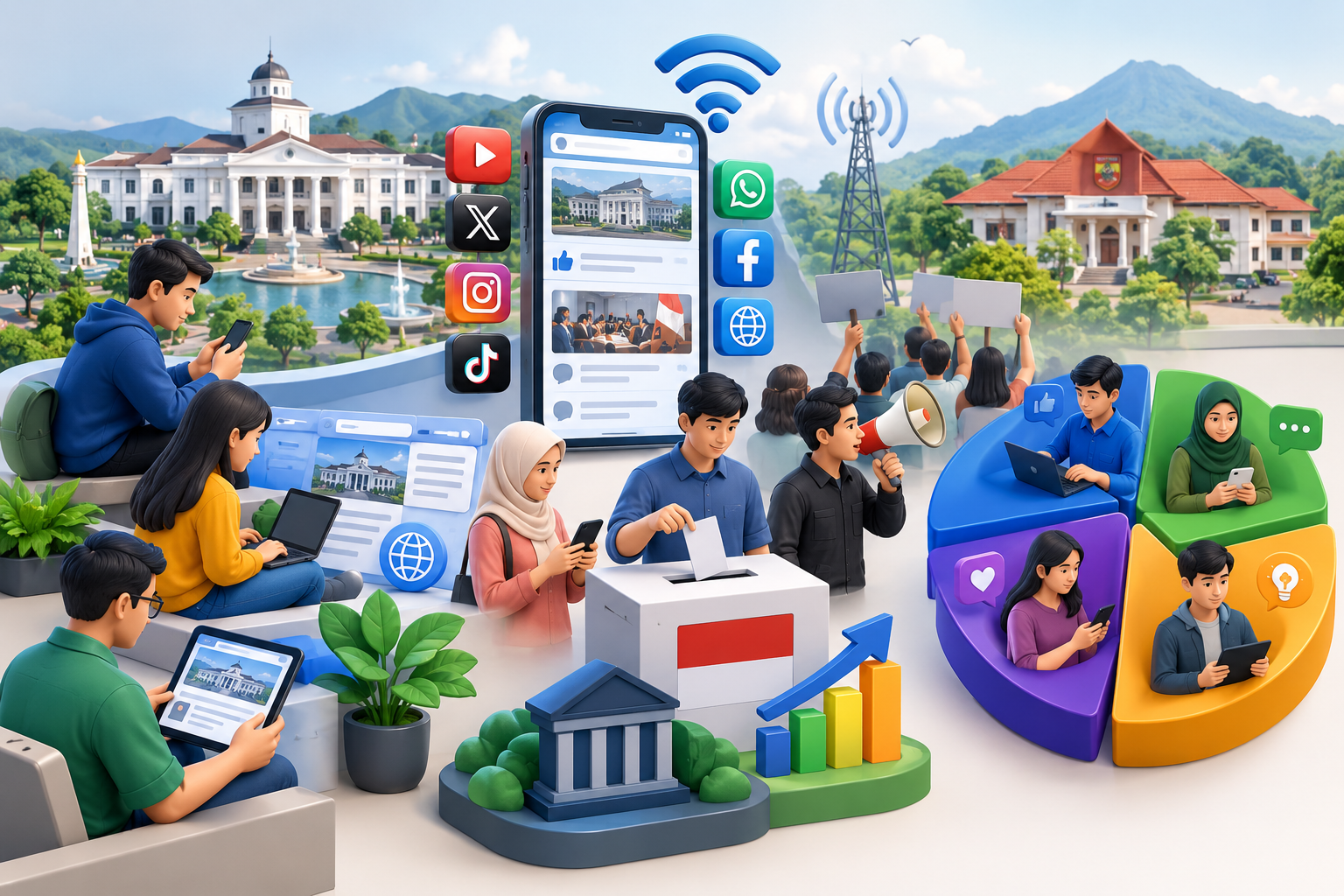
The digital transformation in Indonesia has led to a paradox in which rapid internet penetration has not proportionally increased political participation, particularly at the local level. Bogor City and Bogor Regency, with West Java internet penetration reaching 82.73% in 2024, represent an ideal urban-periurban laboratory to examine this phenomenon. This study aims to (1) analyze the influence of digital media information access on political participation, (2) compare digital media access and political participation between Bogor City and Bogor Regency, and (3) identify political participation typologies based on digital media information access. A quantitative cross-sectional survey was conducted involving 404 respondents registered in the 2024 Regional Election Permanent Voter List. Data were analyzed using simple linear regression, Spearman's Rho correlation, Mann-Whitney U test, and K-Means Clustering. Results indicate that digital media information access has a positive and significant effect on political participation (B = 0.349; F = 55.605; Sig. < 0.001; R² = 12.2%), with a weak-to-moderate correlation (r = 0.320). No significant differences were found between Bogor City and Bogor Regency in either digital media access (Sig. = 0.840) or political participation (Sig. = 0.321). K-Means Clustering identified three distinct typologies: Active Participants (high access, high participation), Moderate Participants (medium access, medium participation), and Passive Participants (low access, low participation). These findings confirm the multi-level digital divide framework and the participation typology, revealing that access intensity rather than geography is the primary determinant of civic engagement patterns.
References
Anggraeni, K. A. R., Permatasari, O. D., Widjaya, M. F. P., Hawari, H., Yuandari, W., & Jayawinangun, R. (2025). From Connectivity to Commitment : How Political Information Sources Shape Voter Participation in Bogor City and Regency. International Journal of Business, Economics and Social Development, 6(4), 573–581. https://doi.org/https://doi.org/10.46336/ijbesd.v6i4.1 106
APJII. (2024). Laporan Survei Penetrasi Internet Indonesia 2024. Asosiasi Penyelenggara Jasa Internet Indonesia. https://apjii.or.id
Arini, N. (2024). 2024 Simultaneous Regional Elections : Examining The Factors Behind Low Voter Turnout (Vol. 16, Issue 23). https://berkas.dpr.go.id/pusaka/files/info_singkat/Inf o Singkat-XVI-23-I-P3DI-Desember-2024-2343- EN.pdf
Boulianne, S. (2018). Twenty Years of Digital Media Effects on Civic and Political Participation. 47(7), 1–20. https://doi.org/10.1177/0093650218808186
Boulianne, S., Copeland, L., & Koc-michalska, K. (2024). Digital media and political consumerism in the United States , United Kingdom , and France. 26(4), 2110–2130. https://doi.org/10.1177/14614448221083025
Bramasta, A. S., & Pierewan, A. C. (2023). Intensitas akses media digital dan partisipasi politik di Indonesia : data WVS7 2018. Dimesia: Jurnal Kajian Sosiologi, 12(02), 99–111. https://doi.org/https://doi.org/10.21831/dimensia.v1 2i2.60992
Desersiis, M. (2021). Reducing the Burden of Decision in Digital Democracy Applications: A Comparative Analysis of Six Decision-making Software. Science, Technology, & Human Values, 48(2), 401–427. https://doi.org/https://doi.org/10.1177/01622439211 054081
Dwitama, M. I., Hakiki, F. A., Sulastri, E., Usni, & Gunanto, D. (2022). Media Sosial Dan Pengaruhnya Terhadap Partisipasi Politik Masyarakat Di Pilkada 2020 Tangerang Selatan. Jurnal Politik Indonesia Dan Global, 3(1), 54–66. https://doi.org/10.24853/independen.x.x.xx-xx ,
K., Wong, P. W. C., Law, Y. W., & Yip, P. S. F. (2016). Building a typology of young people ’ s conventional and online political participation : A randomized mobile phone survey in Hong Kong , China. Journal of Information Technology & Politics, 3(2), 126– 141. https://doi.org/http://dx.doi.org/10.1080/19331681.2 016.1158138
Hadi, A. (2018). Bridging Indonesia’s Digital Divide : Rural-Urban Linkages ? Digital Divide: Rural-Urban Linkages?, 22(1), 17–33. https://doi.org/10.22146/jsp.31835
Hunawa, R., & Polinggapo, J. (2025). Rational Voters and Emotional Voters : Analysis of Socio-Psychological Factors in Voting Behavior in the 2024 Presidential Election. Public Policy Journal, 6(1), 40–53. https://doi.org/10.37905/ppj.v6i1.2872
Jayawinangun, R., & Valdiani, D. (2020). Tipologi Partisipasi Politik Pemilih Laki-Laki Di Kabupaten Bogor Berdasarkan Penggunaan Sumber Informasi Politik. Interaksi: Jurnal Ilmu Komunikasi, 9(1), 31– 39. https://doi.org/https://doi.org/10.14710/interaksi.9.1. 31-39
Lehdonvirta, V., Oksanen, A., Räsänen, P., & Blank, G. (2020). Social Media , Web , and Panel Surveys : Using Non ‐ Probability Samples in Social and Policy Research. 134–155. https://doi.org/10.1002/poi3.238
Lestari, A. P., & Rohimakumullah, M. A. A. (2022). Strategi Pengelolaan Instagram Sebagai Media Informasi Publik Oleh Pemkot Bogor Di Masa Pandemi Covid-19. 11(1). https://doi.org/10.21070/kanal.v11i1.1686
Lorenz-spreen, P., Oswald, L., Lewandowsky, S., & Hertwig, R. (2023). A systematic review of worldwide causal and correlational evidence on digital media and democracy. Nature Human Behaviour, 7, 74–101. https://doi.org/10.1038/s41562-022-01460-1
Nanjundeswaraswamy, & Divakar, S. (2021). Determination Of Sample Size And Sampling Methods In Applied Research. Proceedings on Engineering Sciences, 03(1), 25–32. https://doi.org/10.24874/PES03.01.003
Nieminen, P. (2022). Application of Standardized Regression Coefficient in Meta-Analysis. BioMedInformatics, 2(3), 434–458. https://doi.org/https://doi.org/10.3390/biomedinform atics2030028
Oser, J. (2017). Assessing How Participators Combine Acts in Their ‘“ Political Tool Kits ”’: A PersonCentered Measurement Approach for Analyzing Citizen Participation. Social Indicators Research, 133(1), 235–258. https://doi.org/10.1007/s11205- 016-1364-8
Papathanassopoulos, S. (2025). Political Communication in the Age of Platforms. Encyclopedia, 5(2), 77. https://doi.org/https://doi.org/10.3390/encyclopedia5 020077
Rapeli, L. (2022). What is the best proxy for political knowledge in surveys ? PLoS One, 17(8), 1–18. https://doi.org/https://doi.org/10.1371/journal.pone.0 272530
Ratnamulyani, I. A., & Maksudi, B. I. (2018). Peran Media Sosial Dalam Peningkatan Partisipasi Pemilih Pemula Dikalangan Pelajar Di Kabupaten Bogor. Sosiohumaniora - Jurnal Ilmu -Ilmu Sosial Dan Humaniora, 20(2), 154 –161. https://doi.org/https://doi.org/10.24198/sosiohumaniora.v20i2.13965
Ridha, M., & Riwanda, A. (2020). Literasi Media, Literasi Politik, Dan Partisipasi Kewarganegaraan Pemilih Pemula Di Era Digital. Jurnal Ilmiah Pendidikan Pancasila Dan Kewarganegaraan, 5(1), 110 –121. https://doi.org/http://dx.doi.org/10.17977/um019v5i 1p11 0 -121
Rohendi, & Muzzammil, F. (2021). Tipologi Pemilih Pemula pada Pilkada Jabar 2018 Studi tentang Tipe Pemilih dari Kalangan Remaja di Kabupaten Purwakarta. Jurnal Adhyasta Pemilu, 4(1), 46 –65.
Sugandi, E. A., Putri, T. E., & Vermonte, P. (2024). Bright Prospect , Lingering Shadows Toward an Inclusive Digital Transformation in Indonesia (N. Shimomura & J. A. Sopacua (eds.)). UNDP Indonesia. https://www.undp.org/indonesia/publications/policy -volume-bright-prospect-lingering-shadows-towardinclusive-digital-transformation
Syamsu, S., Ansar, M. C., & Nurlinah. (2025). Impact of class configuration on political participation : Evidence from Gowa Regency , Indonesia. Front. Polit. Sci. 7:1544614. https://doi.org/10.3389/fpos.2025.1544614
Van Djik, J. (2019). Afterword : The State of Digital Divide Theory .
Widodo, S., & Kristiyanto, J. (2025). Digital democracy : transforming political communication in Indonesia. Jurnal Studi Komunikasi, 9(1), 153 –168. https://doi.org/10.25139/jsk.v9i1.9524
Zack, E. S., Kennedy, J. M., & Long, J. S. (2019). Can nonprobability samples be used for social science research ? A cautionary tale. Journal of the European Survey Research Association, 13(2), 215 –227. https://doi.org/https://doi.org/10.18148/srm/2019.v1 3i2.7262
Zainudin, A. (2024). Peran Media Sosial Dalam Meningkatkan Partisipasi Generasi Z Di Pedesaan Pada Pemilu Tahun 2024 Suatu Studi Di Desa Sungai Ana Kecamatan Sintang. FOKUS (Publikasi Ilmiah Untuk Mahasiswa, Staf Pengajar Dan Alumni Universitas Kapuas Sintang), 22(2), 295 –303. https://doi.org/https://doi.org/10.51826/fokus.v22i2. 1232
Zetra, A., & Marisa, S. (2022). Political Awareness, Knowledge, And Participation Relationship Using Structural Equation Modeling Approach. Jurnal Wacana Politik, 7(1), 46 –56. https://doi.org/https://doi.org/10.24198/jwp.v7i1.36 325
Downloads
Published
How to Cite
License
Copyright (c) 2026 Mochammad Fahrezi Putra Widjaya, Roni Jayawinangun, dan Ahsani Taqwim Aminuddin

This work is licensed under a Creative Commons Attribution 4.0 International License.