The Kitchen as Space: A Critical Discourse Analysis of Gender Representation at Babalu Cafe and in Farida Nurhan’s YouTube Content
Dapur sebagai Ruang: Analisis Wacana Kritis tentang Representasi Gender di Babalu Cafe dan Konten YouTube Farida Nurhan
Keywords:
discourse analysis, the kitchen as a space, gender, YouTubeAbstract
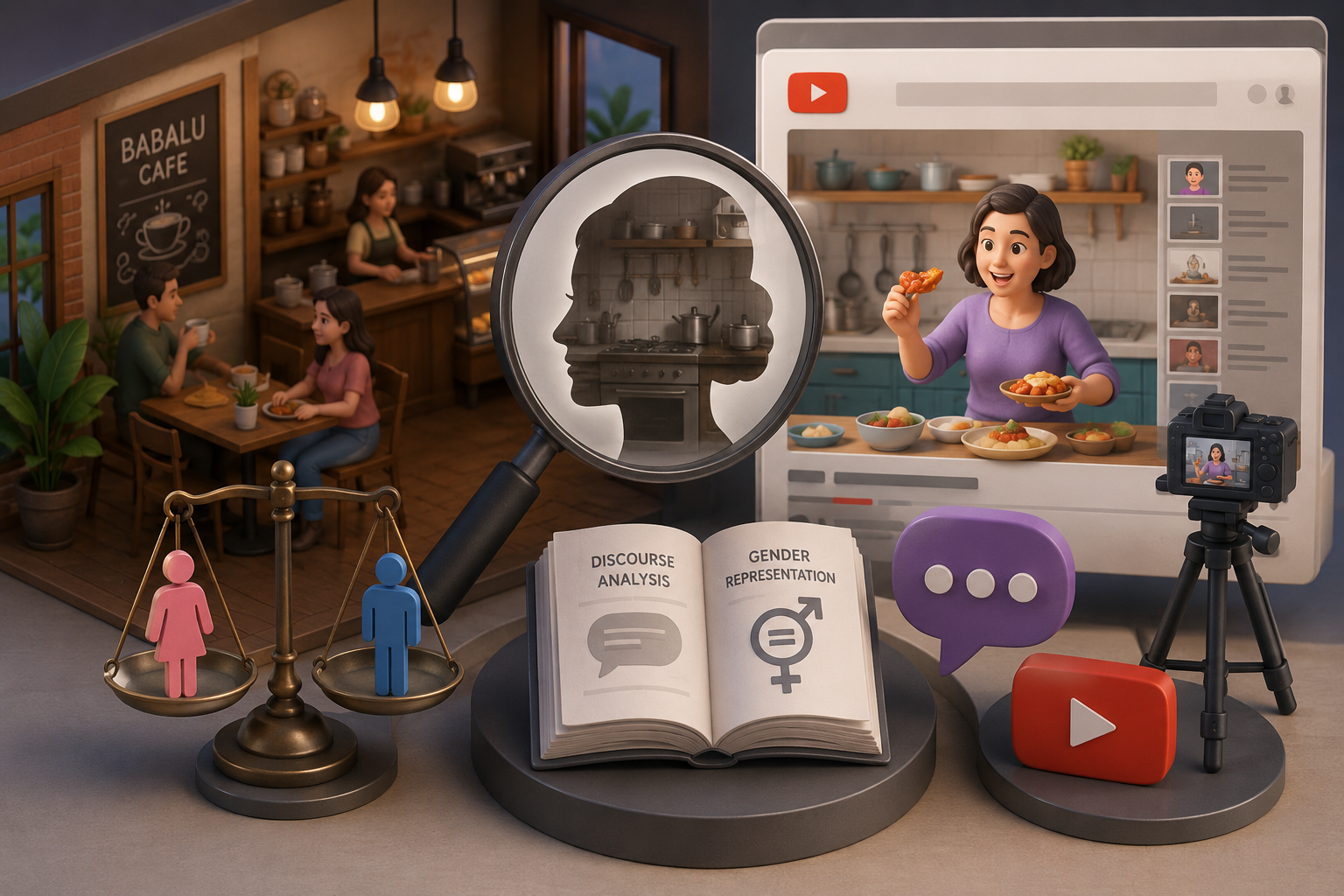
The advent of social media particularly YouTube—has transformed many aspects of life, including how the kitchen is interpreted as a space for the production of meaning, particularly regarding gender. This stands in contrast to the past, when the kitchen was viewed as a secluded domestic space. This article examines critical discourses surrounding gender representation, focusing on Babalu Cafe and Farida Nurhan as YouTube creators selected to exemplify the discourse of the kitchen as a space. A qualitative approach was employed, utilizing observation and literature review for data collection. Data gathered from seven YouTube videos were categorized into primary data (videos from the Babalu Cafe and Farida Nurhan channels) and secondary data (coverage videos by Mgdalenaf, Dyodoran, and Bang Tarjo Vlog). The study yielded three key findings: (1) at the textual dimension, the two creators construct the meaning of the kitchen differently through their choice of jargon, title and thumbnail strategies, and the use of audience nicknames to evoke emotional responses; (2) at the discursive practice dimension, the kitchen is represented as a "cooking space" by the male creator through a "rebel cooking" style, whereas the female creator represents it as a "kitchen space" through aesthetics, taste, and interpersonal relationships; (3) at the social practice dimension, kitchen representations reflect the reproduction of patriarchal ideology, the gendered professionalization of cooking, the commodification of the kitchen within the creator economy ecosystem, social class contestation through lifestyle, and the naturalization of gender ideology via digital entrepreneurialism.
References
07skertches. (2020). Kitchen Design. Instagram.
Allan, Keith; Burridge, K. (2006). Forbidden words: Taboo and The Censoring of Language. Cambridge University Press.
Budiwiyanto, J. (2006). Kitchen Set: Pola Penataan dan Perawatannya pada Rumah Tinggal. Jurnal Seni Rupa STSI Surakarta, 3(2), 1–13.
Buscemi, F. (2014). Television as a Trattoria: Constructing The Woman in The Kitchen on Italian Food Shows. European Journal of Communication, 29(3), 304–318. https://doi.org/https://doi.org/10.1177/0267323114523147
Butar Butar, Christhoper Rafael; Ali, D. S. F. (2018). Strategi Personal Branding Selebgram Non Selebriti. Profesi Humas: Jurnal Ilmiah Ilmu Hubungan Masyarakat, 2(2), 86–101. https://jurnal.unpad.ac.id/profesi-humas/article/view/12029
Butler, J. (2006). Gender Trouble: Feminism and The Subversion of Identity. Roudledge Classics.
Christie, M. E. (2006). Kitchenspace: Gendered Territory in Central Mexico. Place and Culture, 13(6), 653–661.
CrabTV, B. (2024). Babalu Cafe. YouTube. https://www.youtube.com/shorts/iCTY1g9dusA
Creswell, John W.; Creswell, D. J. (2023). Research Design: Qualitative, Quantitative, and Mixed Methods Approaches. SAGE Publications.
Cui,G., Chung,Y., Peng,L., & Wang, Q. (2024). Clicks for Money: Predicting Video Views Through a Sentiment Analysis of Titles and Thumbnails. Journal of Business Research. https://doi.org/https://doi.org/10.1016/j.jbusres.2024.114849
Dalla-Camina, M. (2017). What Do You Want To Be Known For? Huffpost.
Dyodoran. (2019). Sok Kabeeh Loss!! Chef Barbar Wajan Sampai Jebol!! YouTube. https://www.youtube.com/watch?v=UNSlRRUgKwg
Fairclough, N. (1992). Discourse and Social Change. Cambridge: Polity Press.
Frida, T. (2023). Farida Nurhan “Omay” Ngaku Dipalak Tempat Makan, padahal Direview Gratis. Viva. https://www.viva.co.id/showbiz/gosip/1603543-farida-nurhan-omay-ngaku-dipalak-tempat-makan-padahal-direview-gratis
Friedman, L. W. (2008). The New Media Technologies: Overview and Research Framework. 1(April), 105–112.
Gabriella, V. (2023). Seni Copywriting: Dari Tulisan jadi Cuan. PT Gramedia, Jakarta.
Hamburg, Myrte E.; Finkenauer, Catrin; Schuengel, C. (2014). Food for Love: The Role of Food Offering in Empathic Emotion Regulation. Frontiers in Psychology, 5, 32. https://doi.org/10.3389/fpsyg.2014.00032
Hand, Martin; Shove, E. (2004). Orchestrating concepts: Kitchen Dynamics and regime change in Good Housekeeping and Ideal Home, 1922–2002. Journal of Home Cultures, 1(3), 235–257. https://doi.org/10.2752/174063104778053464
Hannan, J. (2018). Carnivalesque Food Videos: Excess, Gender and Affect on Youtube. NECSUS: European Journal of Media Studies, 7(2), 73–96. https://doi.org/10.25969/mediarep/3451
Hayati, K., & Saraswati, D. P. (2023). Analisis Strategi Komunikasi Pengguna Media Sosial Instagram Non-Celebrity dalam Membentuk Personal Branding. Avant Garde, 11(2), 260. https://doi.org/10.36080/ag.v11i2.2557
Heath, M. (2018). Orthography in Social Media: Pragmatic nd Prosodic Interpretations of Caps Lock. Proceedings of the Linguistic Society of America, 3(1), 55:1–13. https://doi.org/10.3765/plsa.v3i1.4350
Insight, G. M. (2026). Statistik Youtube 2026 (Demografi, Pengguna Berdasarkan Negara & Lainnya). Global Media Insight. https://www.globalmediainsight.com/blog/youtube-users-statistics/
Juhasz, A. (2009). Learning The Five Lessons of Youtube: After Trying To Teach There, I Don’t Believe The Hype. Cinema Journal, 48(2), 145–150.
Ketchum, C. (2005). The Essence of Cooking Shows: How The Food Network Constructs Consumer Fantasies. Journal of Communication Inquiry, 29(3), 217–234. https://doi.org/https://doi.org/10.1177/0196859905275972
Koh, Byungwan; Cui, F. (2022). An Exploration of The Relation Between The Visual Attributes of Thumbnails And The View-Through of Videos: The Case of Branded Video Content. Decision Support Systems, 160. https://doi.org/10.1016/j.dss.2022.113820
Ledin, P., & Machin, D. (2019). Forty Years of IKEA Kitchens and The Rise of a Neoliberal Control of Domestic Space. Visual Communication, 18(2), 165–187. https://doi.org/10.1177/1470357218762601
Lewis, R. (2020). This Is What the News Won’t Show You”: YouTube Creators and the Reactionary Politics of Micro-celebrity. Television & New Media. https://doi.org/https://doi.org/10.1177/1527476419879919
Llewellyn, M. (2004). Designed by Women and Designing Women: Gender, Planning and The Geographies of The Kitchen in Britain 1917–1946. Cultural Geographies, 11(1), 42–60. https://doi.org/10.1191/1474474003eu292oa
Lukman Hakim. (2023). Kritik Stereotipe Perempuan Pekerja Domestik di Media Sosial. Jurnal Media dan Komunikasi, 4(1), 46–61. https://doi.org/10.20473/medkom.v4i1.47841
Matwick, K., & Matwick, K. (2015). Inquiry in Television Cooking Shows. Discourse & Communication, 9(2), 313–330. https://doi.org/https://doi.org/10.1177/1750481315576629
Mauliza, Chusna A.; Winarti, D. (2024). Medan Makna Leksikon ‘Makan’ dalam Bahasa Jawa di Yogyakarta. Jurnal Ikabudi, 13(2), 101–112.
Mgdalenaf. (2019). Lempar Beling, Banting Kompor, Mukbang Bareng Chef Sok Kabehh! YouTube. https://www.youtube.com/watch?v=-SReFTvucEI
Moleong, L. J. (2005). Metodologi penelitian kualitatif (21st ed.). PT Remaja Rosdakarya21.
Morissan. (2008). Jurnalistik Televisi Mutakhir.
Nurhan, F. (2021). Di Tantang Ngabisin Oseng Daging Level 500!!! Shanty Denny Ratu Cabe Yang Sesungguhnya…. YouTube. https://www.youtube.com/watch?v=tf3pu4C3uQA
Nurhan, F. (2023). Selamat Tinggal Dapur Termahal Di Seluruh Dunia, Trimakasih Untuk Semuanya! YouTube. https://www.youtube.com/watch?v=iRIK5dzN7dk&t=55s
O’Neill, M. G. (2014). Transgender Youth and YouTube Videos: Self-Representation and Five Identifiable Trans Youth Narratives. In Queer Youth and Media Cultures (pp. 34–45). https://doi.org/https://doi.org/10.1057/9781137383556_3
Permana, R., Trikusumaningtias, I., & Adinugroho, P. (2024). Freedom of Speech di Ruang Virtual : Analisis Wacana. 5(3), 3199–3210.
Rachmah, I. (2016). Metode Penelitian Studi Media dan Kajian Budaya. Kencana.
Salsabila, Imelda Febi; Munazharoh, H. (2024). Bahasa persuasi dalam video YouTube food vlogger MGDALENAF. Kajian Linguistik dan Sastra, 9(2), 219–236. https://doi.org/10.23917/kls.v9i2.6330
Samal, R., & Mishra, B. (2025). (En)gendering Indian Kitchen: Discourses of Gender, Space and Women in Ambai’s “A Kitchen in The Corner oof The House.” Journal for Cultural Research, 29(3), 320–331. https://doi.org/https://doi.org/10.1080/14797585.2025.2454631
Satori, Djam’an; Komariah, A. (2010). Metodologi Penelitian Kualitatif. Alfabeta.
Septiani, Intan Yusan; Siscawati, M. (2022). Chef Minoritas Di Tempat Kerja: Perempuan di Dapur Profesional. Paradigma: Jurnal Kajian Budaya, 12(2), 121–135. https://doi.org/10.17510/paradigma.v12i2.564
Southerton, D. (2001). Consuming Kitchens: Taste, Cooking and Identity. Journal of Consumer Culture, 1(2), 179–203. https://doi.org/10.1177/146954050100100202
Tarjo, B. (2024). Seafood Sok Kabeh Yang Terkenal Di Kota Purwodadi. YouTube. https://www.youtube.com/shorts/-AIac2nEGFk
Thrift, N. (2006). Space. Theory, Culture & Society, 23(2–3), 139–146. https://doi.org/https://doi.org/10.1177/0263276406063780
Thwaites, Tony., Davis, Lloyd., Mules, W. (2002). Introducing Cultural and Media Studies: a Semotic Approach. Palgrave.
West, C.; Zimmerman, D. H. (1987). Doing Gender. Jstor, 1(2), 125–151. https://www.jstor.org/stable/189945
West, Candance; Zimmerman, D. H. (2009). Accounting for Doing Gender. Gender & Society, 23(1), 112–122.
Downloads
Published
How to Cite
License
Copyright (c) 2026 Kumala Hayati

This work is licensed under a Creative Commons Attribution 4.0 International License.