The Role of Universities in Pentahelix Collaboration to Enhance Tsunami Preparedness in South Lebak
Peran Universitas dalam Kolaborasi Pentahelix untuk Meningkatkan Kesiapsiagaan Tsunami di Lebak Selatan
Keywords:
Communication Strategies, DisasterAbstract
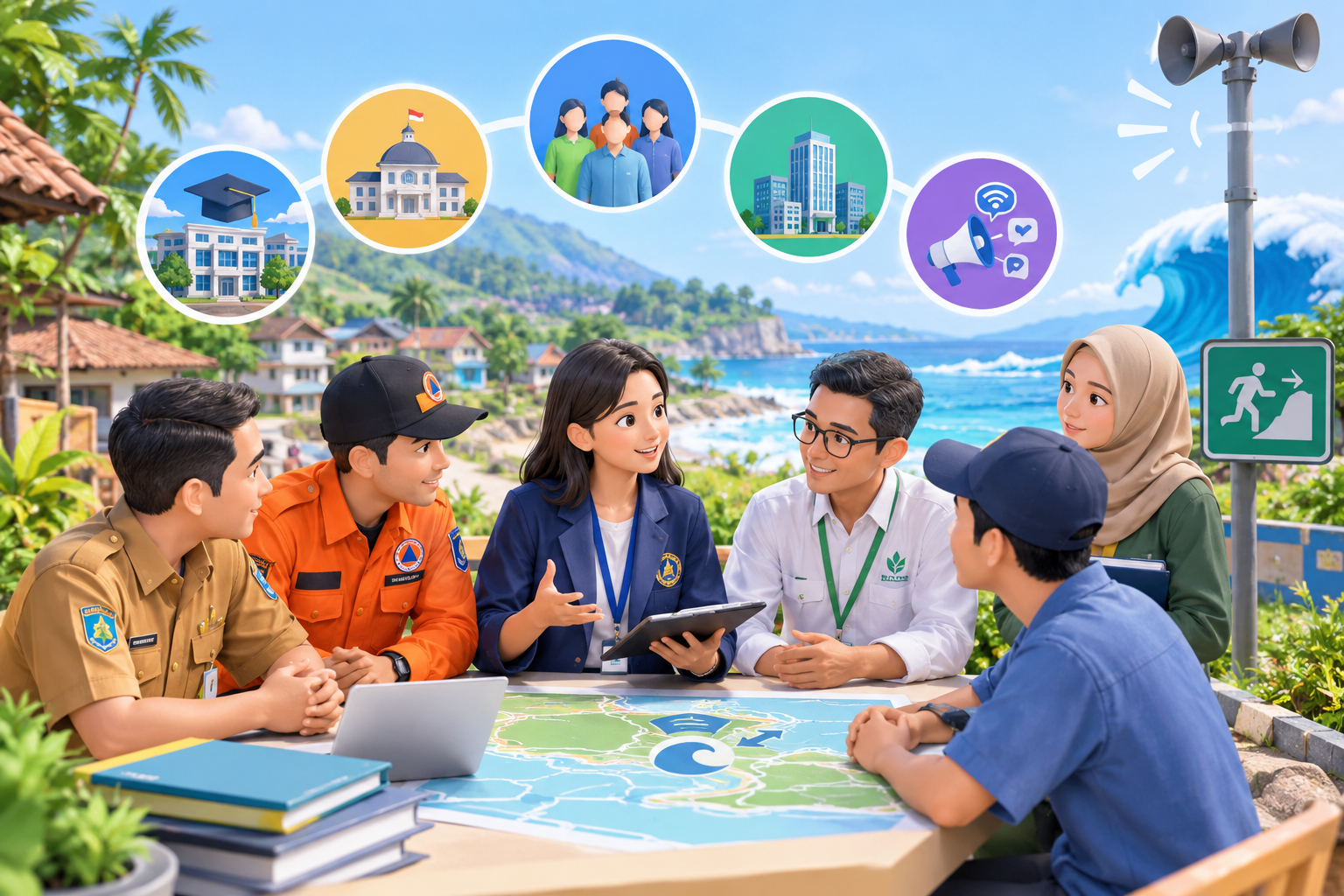
Achieving Tsunami-Ready status in Panggarangan Village, Lebak Regency, Banten, which has received international recognition from UNESCO, requires strong community cohesion and coordinated collective action. This study focuses on the strategic collaboration between Multimedia Nusantara University (UMN) and the local grassroots organization, the South Lebak Disaster Mitigation Task Force (Gugus Mitigasi Lebak Selatan, GMLS). UMN’s involvement, particularly through the Humanitarian Project initiated by its Strategic Communication Study Program, centers on its role as a neutral platform for knowledge transfer. This study aims to examine how collaboration between UMN and GMLS has successfully bridged social fragmentation within the local community to enhance tsunami preparedness. A qualitative approach was employed, using field observations, in-depth interviews, documentation, and student participation through the Humanitarian Project. By integrating local wisdom with scientific knowledge, the project brings together diverse community groups through a shared understanding of disaster safety. The findings indicate that the collaborative program between GMLS and UMN has successfully fostered cohesion in support of Tsunami-Ready preparedness in South Lebak. The study concludes that educational literacy programs delivered through UMN’s Strategic Communication Study Program have contributed to the fulfillment of Indicators 6, 7, and 8 of the 12 Tsunami-Ready indicators. This research is expected to serve as a model for university–community collaboration in developing disaster literacy, strengthening social cohesion, and supporting the sustainability of Tsunami-Ready status in disaster-prone areas.
References
Alexander, D. (2015). Disaster management and social cohesion. Journal of Contingencies and Crisis Management, 23(4), 223–231. https://doi.org/10.1111/1468-5973.12097
Armayanti, N., Kholis, A., & Pramana, D. (2026). The role of the Pentahelix model in enhancing disaster management effectiveness and post-disaster recovery in North Sumatra and Aceh. Inovasi: Jurnal Politik dan Kebijakan, 23(1), xx–xx.
Badan Nasional Penanggulangan Bencana. (2020). Pedoman desa tangguh bencana. BNPB.
Becker, J., et al. (2015). Communicating earthquake and tsunami risk. International Journal of Disaster Risk Reduction, 10, 1–9. https://doi.org/10.1016/j.ijdrr.2014.07.002
Coulson, N. J. (1968). Islamic law. In J. D. M. Derrett (Ed.), An introduction to legal systems (pp. xx–xx). Sweet & Maxwell.
Fakhruddin, I., & Elmada, M. A. G. (2022). Local wisdom as a part of disaster communication: a study on the local storytelling in disaster mitigation. ETNOSIA: Jurnal Etnografi Indonesia, 7(2), 154-166.
Fridayani, H. D., Isnadi, Y., Atmojo, M. E., Qurotianti, A., & Widyasari, S. (2026). Enhancing disaster preparedness capacity and multi-stakeholder coordination through Penta-Helix collaboration. Engagement: Jurnal Pengabdian kepada Masyarakat, 10(2), 474–490.
Gaillard, J. C., & Mercer, J. (2013). From knowledge to action: Bridging gaps in disaster risk reduction. Progress in Human Geography, 37(1), 93–114. https://doi.org/10.1177/0309132512469637
Izumi, T., & Shaw, R. (2015). Pentahelix collaboration in disaster education. Asian Journal of Disaster Management, 9(3), 201–215.
Lassa, J. (2018). Governance and resilience in disaster risk reduction. Disaster Prevention and Management, 27(4), 404–419. https://doi.org/10.1108/DPM-09-2017-0210
McKee, N. (2004). Communication for social change anthology. Communication for Social Change Consortium.
Muktiyanto, A., et al. (2025). Universities as communication architects in disaster preparedness. Jurnal Manajemen Bencana, 12(2), 101–118.
Mahyaruddin, M., Sofyan, H., & Marthoenis. (2026). Disaster literacy and self-efficacy in flood preparedness: Evidence from Aceh Tamiang, Indonesia. International Journal of Disaster Management, 9(2), 85–104. https://doi.org/10.24815/ijdm.v9.i2.2440
Nara, I., et al. (2025). Collaborative disaster governance in Indonesia: Lessons from Pentahelix. Jurnal Administrasi Publik, 19(1), 33–49.
Pasaribu, R., et al. (2022). Collaborative governance in disaster risk reduction: The Pentahelix approach. Jurnal Kebijakan Publik, 14(3), 211–225.
Paton, D. (2008). Risk communication and community preparedness. Journal of Risk Research, 11(5), 589–606. https://doi.org/10.1080/13669870801936599
Rasidi, A., et al. (2023). Communication challenges in Pentahelix disaster management. Jurnal Komunikasi Indonesia, 8(1), 55–70.
Rahman, A., Hayat, E., Puspita, N. A., Rosemary, R., Artika, W., & Ridha, S. (2026). Determinants of tsunami evacuation intention in Banda Aceh: Institutional trust, preparedness behaviour, and religious perception. International Journal of Disaster Management, 9(1), 14–37. https://doi.org/10.24815/ijdm.v9.i1.1203
Setyawati, L. A. (2024). Strengthening disaster resilience in Indonesia: A framework for sustainable recovery through the Pentahelix model. ICD Information, Communications, and Disaster, 1(2), 85–93.
Shaw, R. (2012). Community-based disaster risk reduction in Asia. International Journal of Disaster Risk Reduction, 2(1), 1–12. https://doi.org/10.1016/j.ijdrr.2011.11.001
Shaw, R., et al. (2014). Education for disaster risk reduction. International Journal of Disaster Risk Science, 5(2), 107–117. https://doi.org/10.1007/s13753-014-0021-0
Shaw, R., et al. (2016). Linking local knowledge and scientific data in tsunami preparedness. Natural Hazards, 84(2), 1123–1140. https://doi.org/10.1007/s11069-016-2460-9
Shaw, R., & Izumi, T. (2014). Civil society organization and disaster risk reduction: The Asian experience. Springer.
Solihin, O., & Nugraha, A. (2022). Komunikasi perubahan sosial dan perilaku. Alfabeta.
Shena, S., & Karamoy, A. The Photobook as a Medium for Cultural Communication: Documentary Photography and Bamboo Heritage in Dusun Ngadiprono. IKAT: The Indonesian Journal of Southeast Asian Studies, 8(1), 87-108.
Subagyo, H., et al. (2022). Multi-stakeholder disaster risk reduction in coastal areas. Jurnal Sosial Humaniora, 10(2), 77–92.
Sutton, J., & Tierney, K. (2006). Disaster preparedness and communication. Journal of Applied Communication Research, 34(1), 3–26. https://doi.org/10.1080/00909880600574138
UNICEF. (2020). Social and behaviour change communication in disaster contexts. Global Communication Review, 5(1), 23–40.
Windiani, R. (2021). The role of media in disaster preparedness. Jurnal Ilmu Komunikasi, 15(2), 145–160.
Wisner, B., Blaikie, P., Cannon, T., & Davis, I. (2004). At risk: Natural hazards, people’s vulnerability and disasters. Routledge.
Downloads
Published
How to Cite
Issue
Section
Categories
License
Copyright (c) 2026 Cendera Rizky Anugrah Bangun, Arindra Khrisna Karamoy, Irwan Fakhruddin

This work is licensed under a Creative Commons Attribution 4.0 International License.